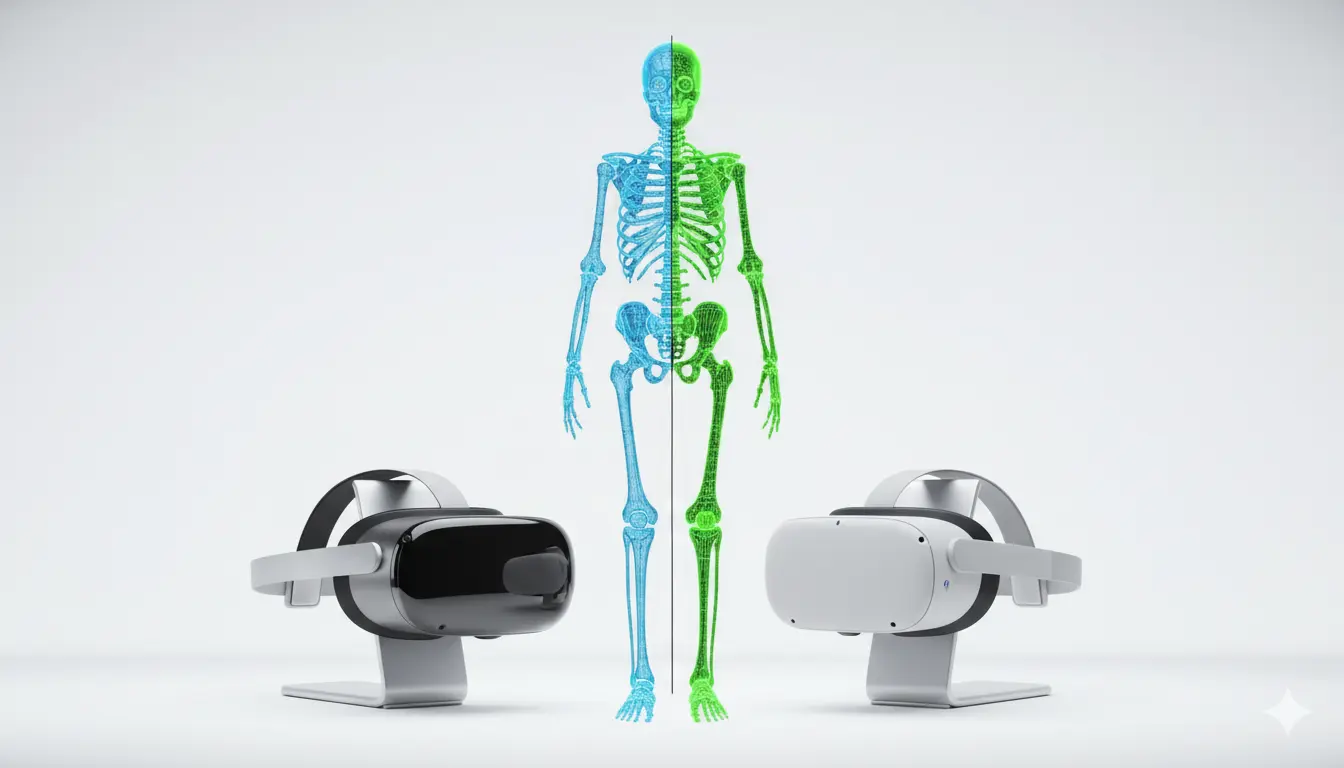
Introduction
Virtual Reality (VR) has become standard in surgical residency programs. The ability to practice a procedure 100 times before touching a patient is invaluable. But for hospital administrators and program directors, the question in late 2025 is: Which hardware do we buy?
We tested the Apple Vision Pro 2 and the Meta Quest 4 (Enterprise Edition) specifically for medical applications.
1. Resolution and Clarity (The “Reading Vitals” Test)
- Apple Vision Pro 2:Â The micro-OLED displays are indistinguishable from reality. You can read small text on a simulated EKG monitor from across the virtual room. For procedures requiring fine visual detail (like microsurgery or ophthalmology), Apple is the undisputed king.
- Meta Quest 4: The resolution is great, but “screen door effect” is still faintly visible at the edges. It’s good enough for general surgery (laparoscopy), but less ideal for microsurgery.
2. Interaction and Haptics (The “Scalpel” Test)
- Apple Vision Pro 2:Â Relies heavily on eye-tracking and hand gestures. While magical for navigation, the lack of physical controllers is a drawback for surgery. You can’t “feel” the resistance of tissue without holding a physical tool.
- Meta Quest 4: This is where Meta wins. The new Touch Pro Haptic Gloves provide force feedback. When you cut through virtual skin vs. bone, the resistance changes. For a resident learning the “feel” of a procedure, this is critical.
3. Ecosystem and Price
- Apple:Â At $3,000+ per unit, it is an investment. The app ecosystem is growing, with “Osso VR” launching a dedicated Vision Pro version this year.
- Meta:Â At $600 per unit, you can outfit an entire classroom of medical students for the price of a few Apple headsets.
The Verdict
Buy the Meta Quest 4 if:Â You are a medical school looking to deploy mass training for students. The haptic feedback and lower cost make it the practical workhorse for “reps and sets.”om library of assets for free. It engages students visually and allows for the visualization of complex diseases that are rarely seen in standard textbooks.y.
Buy the Apple Vision Pro 2 if:Â You are training experienced surgeons on complex anatomy where visual fidelity is everything, or if you are using it for pre-operative planning (overlaying MRI data).