Introduction
For decades, medical educators relied on Netter’s illustrations or expensive stock photography to teach anatomy. If a professor wanted a specific image—say, “a liver showing early-stage cirrhosis next to a healthy liver”—they had to hire a professional medical illustrator or settle for a “close enough” image from Google.
In 2025, Generative Media tools like Midjourney v7 and Stable Diffusion XL have democratized medical visualization. Educators can now conjure accurate, high-fidelity assets in seconds. Here is how they are doing it, and the limitations you need to know.
The Use Case: Custom Pathology
The power of GenAI lies in “rare” combinations.
- Scenario:Â You are teaching a class on diabetic retinopathy.
- The Prompt:Â You can ask the AI to generate:Â “Fundoscopy view of human retina, showing cotton wool spots and microaneurysms, photorealistic, 8k resolution, medical style.”
- The Result:Â You get four variations. You choose the one that best illustrates the pathology for your lecture slides.
Prompt Engineering for Anatomy
Getting medical accuracy requires specific “prompt engineering.”
- Style Keywords: Always use terms like “medical illustration,” “Netter style,” or “MRI scan style” to stop the AI from making it look like a cartoon.
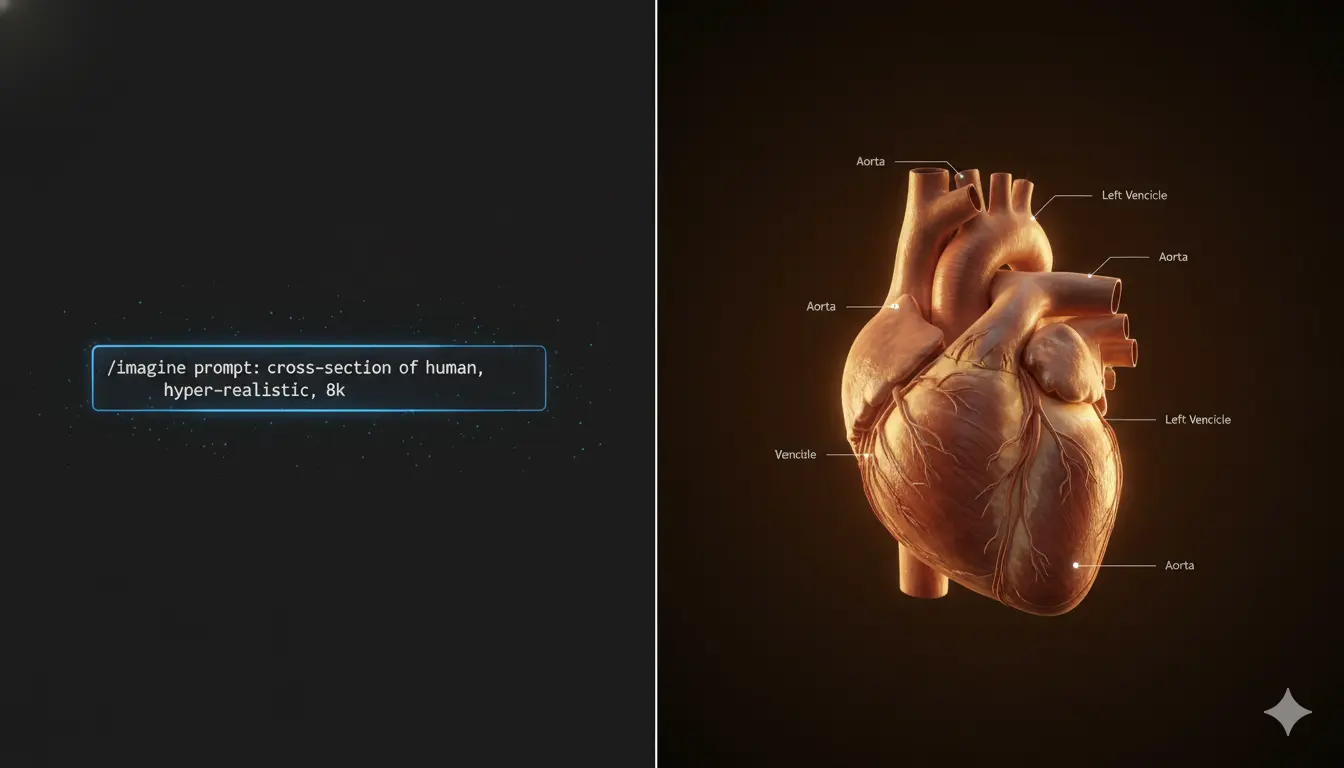
- Anatomical Correctness:Â AI struggles with counting (e.g., it might give a hand six fingers or a heart five chambers). You must verify every image. Using “image-to-image” (giving the AI a crude sketch to follow) helps lock in the correct anatomy.
Tools of the Trade
- Midjourney:Â Best for “artistic” and high-detail textures. Excellent for dermatology images or general organ structures.
- Stable Diffusion (Local):Â Best for privacy. If you are feeding it patient data (anonymized) to generate variations, you should run this locally on your hospital’s secure servers, not the cloud.
The Ethics and Accuracy Warning
Generative AI is a “stochastic parrot”—it guesses what a heart looks like based on millions of images. It does not “know” anatomy.
- The Danger:Â It might invent a blood vessel that doesn’t exist.
- The Rule: These tools are for education and illustration, not for diagnosis. A professor must review the image to ensure the “LAD artery” is actually in the right place before showing it to students.
Conclusion
Generative media allows medical educators to build a custom library of assets for free. It engages students visually and allows for the visualization of complex diseases that are rarely seen in standard textbooks.y.